
Are You Making These Common Oahu Refrigeration Mistakes? Leak Detection & Loss Prevention for Hawaii Businesses

Walk into any commercial kitchen, grocery operation, or hospitality facility across Oahu during peak hours, and you'll witness something remarkable: dozens of refrigeration systems working in concert to keep perishables fresh, beverages cold, and operations running. Until they don't.
The reality of refrigeration service Hawaii businesses face isn't about dramatic equipment failures that announce themselves with sparks and smoke. It's about the quiet, expensive mistakes that compound over months: refrigerant leaks that go undetected, seals that fail incrementally, and maintenance practices that seem adequate until you're staring at spoiled inventory and an emergency repair bill at 2 AM on a Saturday.
Here's what nearly three decades of working with commercial facilities across the islands has taught us: most refrigeration problems aren't equipment problems. They're detection problems, prevention problems, and: if we're being honest: awareness problems.
The Leak You Don't Know About Is Costing You Right Now
Refrigerant leaks represent one of the most insidious issues in commercial refrigeration, primarily because they're excellent at hiding. A system can lose efficiency gradually enough that your team attributes the declining performance to aging equipment, increased demand, or Hawaii's humidity: anything except the actual culprit slowly escaping into the atmosphere.
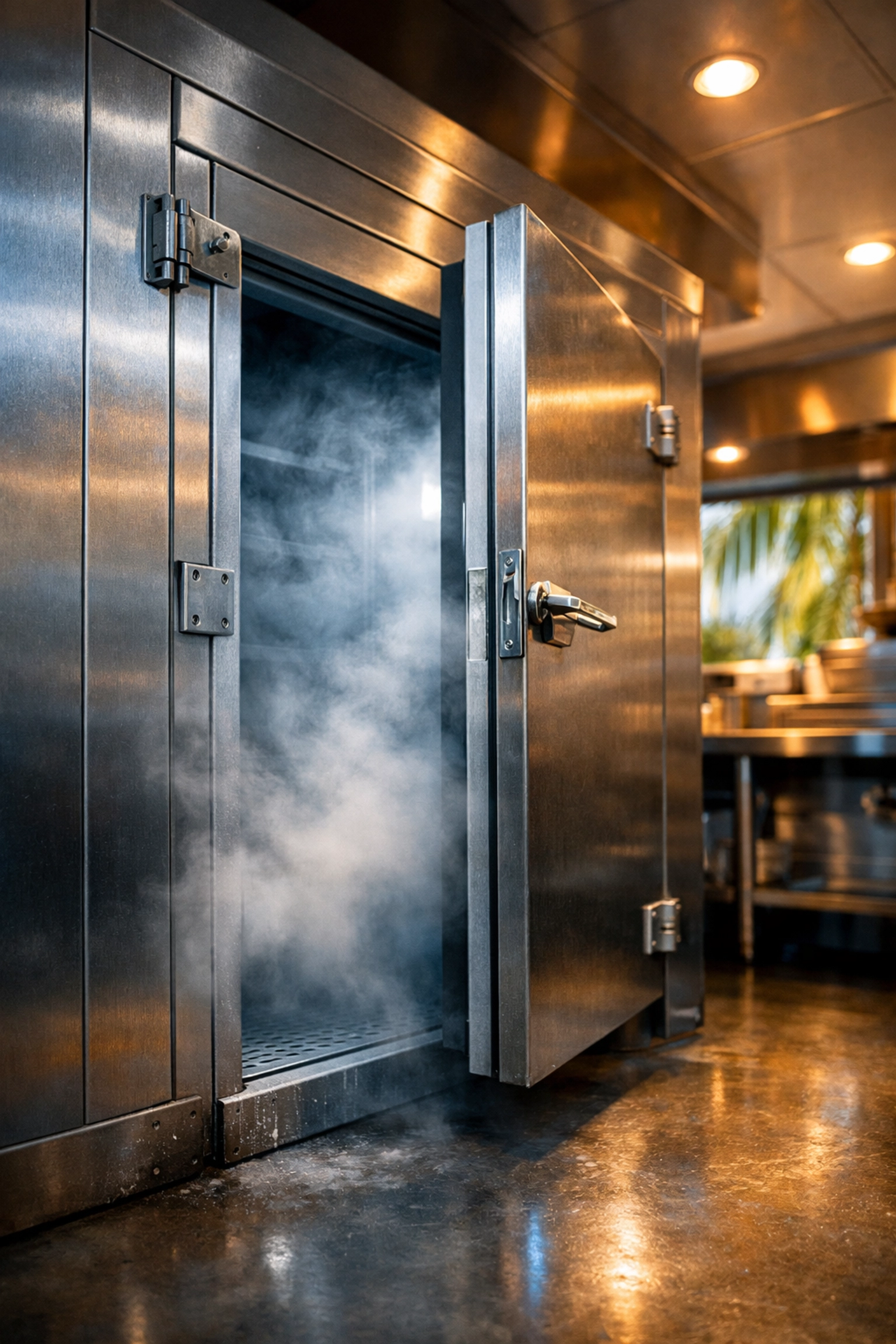
The operational cost breakdown tells the story. A refrigeration system operating with even a 10% refrigerant loss runs significantly harder to maintain target temperatures, translating directly to higher energy consumption. Your compressor cycles more frequently, your evaporator coils struggle to maintain proper temperatures, and your entire system ages faster under the increased load. Meanwhile, your utility bills creep upward in a pattern that seems normal until someone actually measures refrigerant levels and discovers the problem.
What makes Hawaii refrigeration systems particularly vulnerable is the combination of salt air exposure and the constant demand placed on equipment that rarely gets a break. Corrosion accelerates connection points, vibration from continuous operation can compromise fittings, and the temperature differential between conditioned spaces and Hawaii's ambient conditions creates expansion and contraction cycles that stress every seal and joint in the system.
The question worth asking: when was the last time someone actually checked your refrigerant levels with proper instrumentation, rather than simply confirming the system was cooling?
Drain Lines and Water Management: The Unglamorous Problem That Ruins Everything
Water leaks from refrigeration equipment rarely announce themselves as catastrophes. Instead, they present as minor puddles, slightly damp flooring, or that persistent moisture issue your team has learned to mop up during closing procedures. This acceptance of "normal" water presence around refrigeration equipment represents one of the costliest mistakes in commercial operations.
Clogged condensate drain lines create a cascade of problems. The immediate issue: water overflow: damages flooring, creates slip hazards, and in worst-case scenarios, affects adjacent equipment or inventory. But the secondary effects prove more expensive: standing water promotes mold growth, increases humidity in spaces that should be dry, and forces HVAC systems to work harder to compensate for the moisture load.
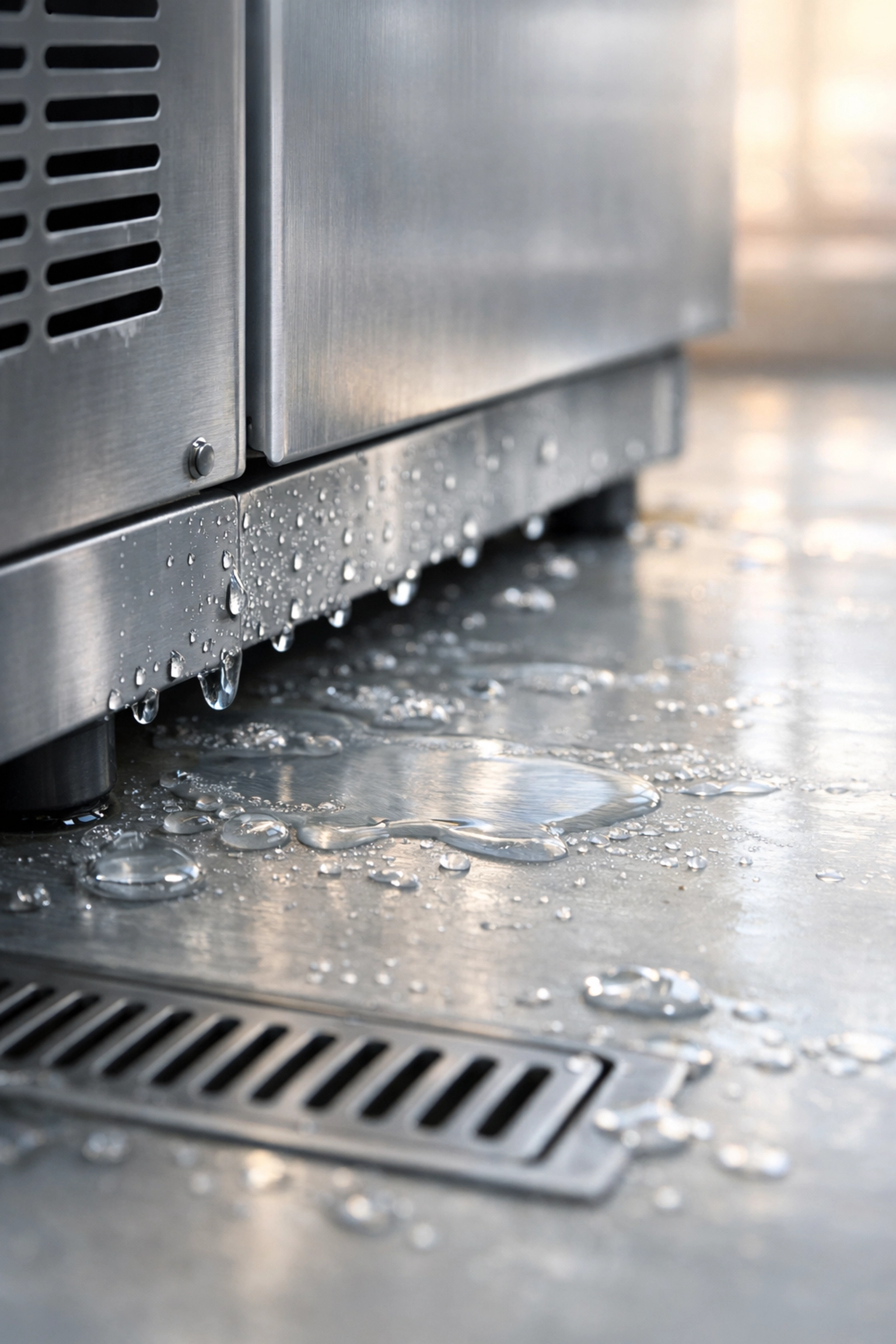
The typical pattern observed across Oahu HVAC and refrigeration installations involves drain pans that go uninspected until they're completely full, drain lines that accumulate organic material and debris until they're fully blocked, and p-traps that dry out during brief shutdown periods and allow odors and warm air to compromise the system.
Hawaii's environment accelerates these issues. Airborne debris, dust, and organic material find their way into systems faster than in drier climates. The constant operation means drain lines never get a break: they're continuously conveying condensate, and when blockages form, they form quickly.
Prevention requires active intervention, not reactive maintenance. High Pressure Hydro Jet Coil Cleaning addresses not just the coils themselves but the entire drainage pathway, clearing accumulations that traditional maintenance approaches leave behind. This isn't about avoiding occasional puddles: it's about preventing the structural damage, mold remediation costs, and potential health code violations that follow sustained water management failures.
Gasket and Seal Failures: The Air Leak Costing Thousands Annually
Walk-in cooler and freezer door gaskets represent one of the highest-return maintenance opportunities in commercial refrigeration, yet they're consistently overlooked until failure becomes obvious. The "obvious" threshold: when you can feel cold air rushing out or see frost formation around the door frame: arrives long after the gasket has been compromising system efficiency.
A failing door seal doesn't just allow cold air to escape; it invites warm, humid Hawaii air into the refrigerated space. Your refrigeration system responds by running longer cycles to maintain temperature. Your evaporator coils ice up faster as moisture freezes on contact. Your compressor works harder, ages faster, and inches closer to failure with every extended run cycle.
The financial impact manifests in three distinct ways: increased energy consumption as the system compensates for air infiltration, accelerated wear on mechanical components from extended operation, and product loss when temperature fluctuations exceed safe thresholds for perishables.
Testing door seals requires nothing more sophisticated than a dollar bill: close it in the door and try to pull it out. If it slides out easily, your seal is compromised. Yet this simple test gets performed far less frequently than it should across commercial facilities.
The same principle applies to display case gaskets, reach-in cooler seals, and any other barrier between refrigerated space and ambient air. In Hawaii's climate, where the temperature and humidity differential between inside and outside refrigeration units remains extreme year-round, seal integrity isn't a minor detail: it's a primary determinant of system efficiency and longevity.
Temperature Monitoring and the Illusion of Control
Many commercial facilities operate under the assumption that their refrigeration systems are maintaining proper temperatures because the digital display shows the target setpoint. This represents a fundamental misunderstanding of the relationship between what a thermostat displays and what's actually happening inside the refrigerated space.
Thermostats fail. Temperature sensors drift out of calibration. Display panels show target temperatures rather than actual temperatures. And by the time someone notices that products don't feel as cold as they should, temperature abuse has already occurred: potentially compromising food safety, product quality, and regulatory compliance.

The traditional approach: periodic manual temperature checks with handheld thermometers: provides snapshots but misses the patterns. A cooler might maintain proper temperatures during morning checks but drift above safe thresholds during peak demand periods. A freezer might experience temperature spikes during defrost cycles that go undetected. A refrigerated display case might maintain acceptable temperatures at the front while the back section runs several degrees warmer.
This is where Smart HVAC Monitoring fundamentally changes the operational equation. Continuous temperature monitoring with real-time alerts transforms refrigeration management from reactive: discovering problems after they've caused damage: to proactive, with early warnings that allow intervention before spoilage, product loss, or system failure occurs.
For property managers overseeing multiple facilities or commercial operations with extensive refrigeration assets, the question becomes straightforward: what's the actual temperature in your refrigerated spaces right now, and how would you know if it changed?
Equipment Placement and Airflow: The Installation Mistakes That Never Get Fixed
Refrigeration equipment needs space to breathe, yet commercial facilities consistently compromise this requirement to maximize usable floor space. Walk-in coolers installed too close to walls, reach-in units positioned in corners where air circulation is restricted, and condensing units placed in mechanical rooms without adequate ventilation: these installation decisions create performance problems that persist for the entire life of the equipment.
The physics involved isn't complicated. Refrigeration systems remove heat from conditioned spaces and reject it to the ambient environment through condensers. When airflow around condensing units gets restricted, heat rejection becomes less efficient. Compressors run longer and hotter. System capacity decreases. Energy consumption increases. Equipment life shortens.
Hawaii's climate intensifies these effects. When ambient temperatures remain elevated year-round and humidity stays high, refrigeration systems already operate at the upper end of their design parameters. Adding airflow restrictions on top of challenging ambient conditions pushes systems beyond their optimal operating range.
The fix often requires nothing more than relocating equipment or removing obstructions, yet these corrections rarely happen because the equipment still functions: it just functions inefficiently, at higher cost, with reduced reliability. The gap between "working" and "working optimally" represents thousands of dollars annually in unnecessary energy costs and premature equipment replacement.
Loss Prevention Through System Visibility
The common thread connecting these refrigeration mistakes is invisibility. Leaks that can't be detected, temperature drift that goes unnoticed, seal failures that happen gradually, and efficiency losses that compound incrementally: none of these issues announce themselves until they've already caused significant damage.
Loss prevention in commercial refrigeration isn't primarily about better equipment or more robust systems. It's about visibility: knowing what's happening with your refrigeration assets in real time, detecting problems while they're still minor, and intervening before small issues become expensive emergencies.
This is where 24/7 emergency repair capability intersects with proactive monitoring. When Smart HVAC Monitoring detects a temperature anomaly at 3 AM, immediate response capability means the difference between a quick fix and a complete refrigerated inventory loss. When leak detection identifies refrigerant loss during early stages, intervention prevents the compounded costs of emergency repairs, lost efficiency, and environmental compliance issues.
For businesses operating in Hawaii's competitive commercial landscape: whether hospitality, food service, retail, or property management: refrigeration reliability directly impacts revenue, reputation, and regulatory compliance. The question isn't whether you can afford sophisticated monitoring and rapid response capabilities. It's whether you can afford not to have them.
The Real Cost of "Good Enough" Refrigeration Management
Most commercial facilities don't fail refrigeration management: they simply accept performance levels that seem adequate. Walk-ins maintain generally acceptable temperatures. Equipment runs without catastrophic failures. Periodic maintenance gets scheduled and completed. Everything appears functional.
The hidden cost lives in the gap between functional and optimized. It's present in the energy bills that could be 15-20% lower with properly maintained systems. It's visible in the equipment that needs replacement after 12 years instead of lasting 18. It's evident in the spoilage write-offs that get categorized as normal cost of doing business. And it accumulates in the emergency repairs that interrupt operations because small problems went undetected until they became urgent.
Nearly three decades working with refrigeration service Hawaii operations across every commercial sector: hospitality, food service, retail, property management, healthcare: reveals a consistent pattern: facilities that implement comprehensive monitoring, maintain aggressive preventive maintenance schedules, and respond rapidly to early warning signs consistently outperform those that take a reactive approach. Not by small margins. By factors that reshape operational economics.
The evaluation question worth considering: if your refrigeration systems were audited today for leak prevention, seal integrity, temperature control accuracy, and overall efficiency: would they earn a passing grade, or would the assessment reveal costly gaps you've been paying for but not measuring?
For Oahu HVAC and refrigeration service needs, the infrastructure supporting Hawaii's commercial operations deserves more than adequate attention. It requires the combination of expert diagnosis, proven maintenance protocols, and monitoring technology that transforms refrigeration from a necessary expense into a managed, optimized asset.
Comments