
What the Holiday Rush Revealed About Your HVAC-R System (And What to Address in Early January)
- Alltemp

- Dec 26, 2025
- 3 min read

The December holiday period quietly places some of the highest sustained demands on HVAC-R systems in Hawaii. Increased occupancy, extended operating hours, and continuous equipment use combine to create a real-world stress test—often revealing performance issues that remain hidden during normal operations.
With year-end celebrations and staffing constraints, most facilities don’t have the opportunity to address these issues immediately. That makes the first week of January a critical window to review what December exposed and take corrective action before problems escalate.
December as an Unplanned HVAC-R Stress Test
Unlike mainland markets, Hawaii doesn’t experience a true cooling off-season. During the holidays, hotels, restaurants, retail spaces, and multi-unit properties often operate at or near peak capacity for extended periods. Systems run longer, recover less frequently, and operate under elevated humidity loads.
This sustained demand doesn’t just test comfort—it tests system balance, controls accuracy, airflow, and refrigeration stability¹².
What the Holiday Rush Commonly Reveals
Capacity Margins That Are Thinner Than Expected

During peak holiday loads, HVAC systems often operate closer to their maximum capacity than at any other time of year. While they may appear adequate under normal conditions, prolonged demand can reveal uneven cooling, slower recovery times, or zones that consistently fall out of range.
What to address in early January:
Review system run times and recovery behavior
Evaluate load distribution and zoning balance
Confirm setpoints align with actual space conditions
Controls and Sensors Drifting Under Continuous Operation

Extended runtimes can expose sensor inaccuracies and control drift, particularly in humid environments. Small calibration issues may not trigger alarms but can cause systems to overwork or short-cycle.
What to address in early January:
Verify thermostat and sensor accuracy
Inspect control logic and scheduling
Review any available trend or runtime data³
Airflow and Filtration Constraints

Higher occupancy leads to faster filter loading and reduced airflow. Over time, restricted airflow increases system strain, impacts humidity control, and accelerates component wear.
What to address in early January:
Replace or upgrade filters
Check static pressure and airflow balance
Inspect coils, drains, and air paths⁴
Refrigeration Systems Showing Early Warning Signs

For food service, hospitality, and cold storage operations, refrigeration systems often reveal performance drift during high-volume service. Longer pull-down times, temperature swings, and increased compressor runtime are common indicators.
What to address in early January:
Inspect refrigerant levels and defrost cycles
Check door gaskets and seals
Confirm alarm thresholds and temperature consistency⁵
Small Issues Turning Into Emergency Repairs
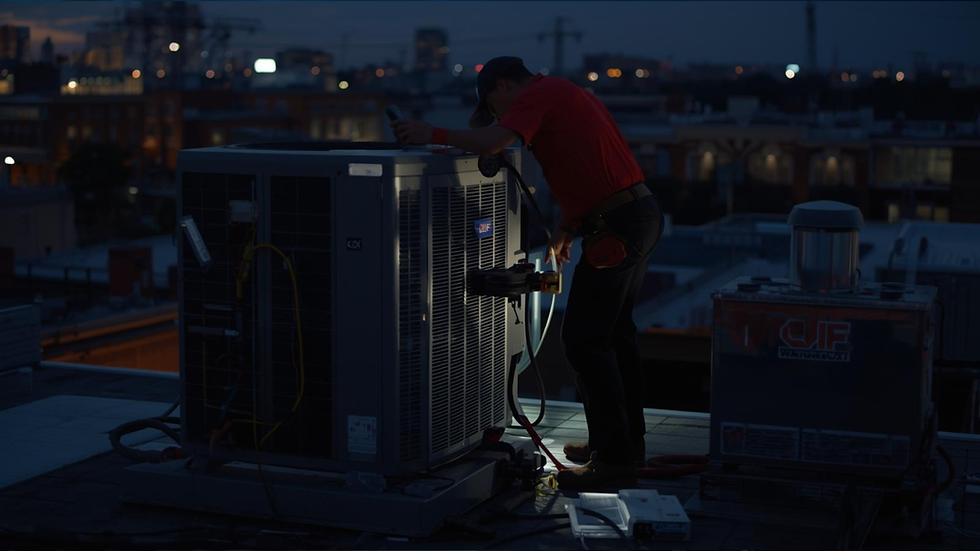
During the holiday rush, minor issues are often deferred to keep operations running. Unfortunately, these deferred items are frequently the root cause of January emergency calls and unplanned downtime.
What to address in early January:
Schedule post-holiday system inspections
Prioritize corrective maintenance over reactive repairs
Reestablish preventive maintenance routines
Why the First Week of January Matters

Once holiday operations wind down, facilities have a narrow opportunity to reset. Addressing performance issues early in January helps prevent compounding wear, reduces the likelihood of emergency failures, and supports more stable operations heading into the new year. Industry guidance consistently shows that most HVAC-R failures originate from unresolved performance degradation rather than sudden component failure⁶.
Using Holiday Performance Data to Plan Ahead
Facilities that track system performance—whether through monitoring platforms or structured maintenance reporting—are better positioned to identify patterns rather than just respond to breakdowns. Runtime data, temperature trends, and alert histories can reveal where systems are gradually losing efficiency or reliability.
Systems that are reviewed proactively don’t just fail less often—they operate more predictably and cost less to maintain over time⁷.
From Holiday Survival to Year-Round Reliability
December's Holiday sprint revealed how your HVAC-R systems perform under sustained demand. Early January is the opportunity to act on those insights—before minor issues become major disruptions. Addressing what the holiday rush exposed helps shift operations from reactive problem-solving back to long-term reliability, efficiency, and control.
Sources
U.S. Department of Energy – HVAC Systems Overviewhttps://www.energy.gov/energysaver/heating-and-cooling
ASHRAE – HVAC System Operation and Load Managementhttps://www.ashrae.org/technical-resources
ASHRAE – HVAC Control Systems and Sensors https://www.ashrae.org/technical-resources/bookstore/controls
U.S. Environmental Protection Agency – Indoor Air Quality & HVAC Maintenancehttps://www.epa.gov/indoor-air-quality-iaq
FDA – Food Service Refrigeration Temperature Controlhttps://www.fda.gov/food
International Facility Management Association (IFMA) – Preventive Maintenance Insightshttps://www.ifma.org
Lawrence Berkeley National Laboratory – HVAC Monitoring & Performance Studieshttps://buildings.lbl.gov
Comments