
7 Mistakes You're Making with Your Refrigeration Service Hawaii (and How to Fix Them)

As we move through the first quarter of 2026, property managers from Kapalua to Waikiki are facing a familiar reality: the relentless Hawaiian climate doesn't take a day off, and neither can your cooling systems. While the start of a new business year often brings focus to budgets and guest occupancy, the mechanical heartbeat of your facility: the refrigeration and HVAC systems: often hums along in the background, unnoticed until it isn't humming anymore.
In the complex ecosystem of Hawaii’s hospitality and food service sectors, a refrigeration failure isn't just a technical glitch; it’s a high-stakes operational crisis. When a walk-in freezer goes down in a Maui resort, it isn't just a repair bill: it’s a $20,000 funeral for premium seafood and a logistical nightmare for your kitchen staff.
Through our observations across the islands, we’ve identified seven critical mistakes that property managers and resort owners frequently make with their refrigeration service Hawaii. These aren't just minor oversights; they are systemic errors that bleed money and shorten the lifespan of your most expensive assets.
1. The "If It Ain't Broke, Don't Fix It" Fallacy
The most common mistake is treating refrigeration and air conditioning maui as reactive services rather than proactive investments. Many facilities wait for an alarm to sound before calling a technician. By the time that alarm rings, the damage is often done.
Reactive maintenance is, by definition, the most expensive way to run a building. You’re paying for emergency labor rates, expedited shipping for parts from the mainland, and the catastrophic cost of lost inventory. In Hawaii, where shipping delays are a way of life, waiting for a failure is a gamble with the house's money. A shift toward predictive maintenance: identifying wear before it leads to a shutdown: is the difference between a profitable quarter and a budgetary disaster.
2. Ignoring the "Salt Air Tax"
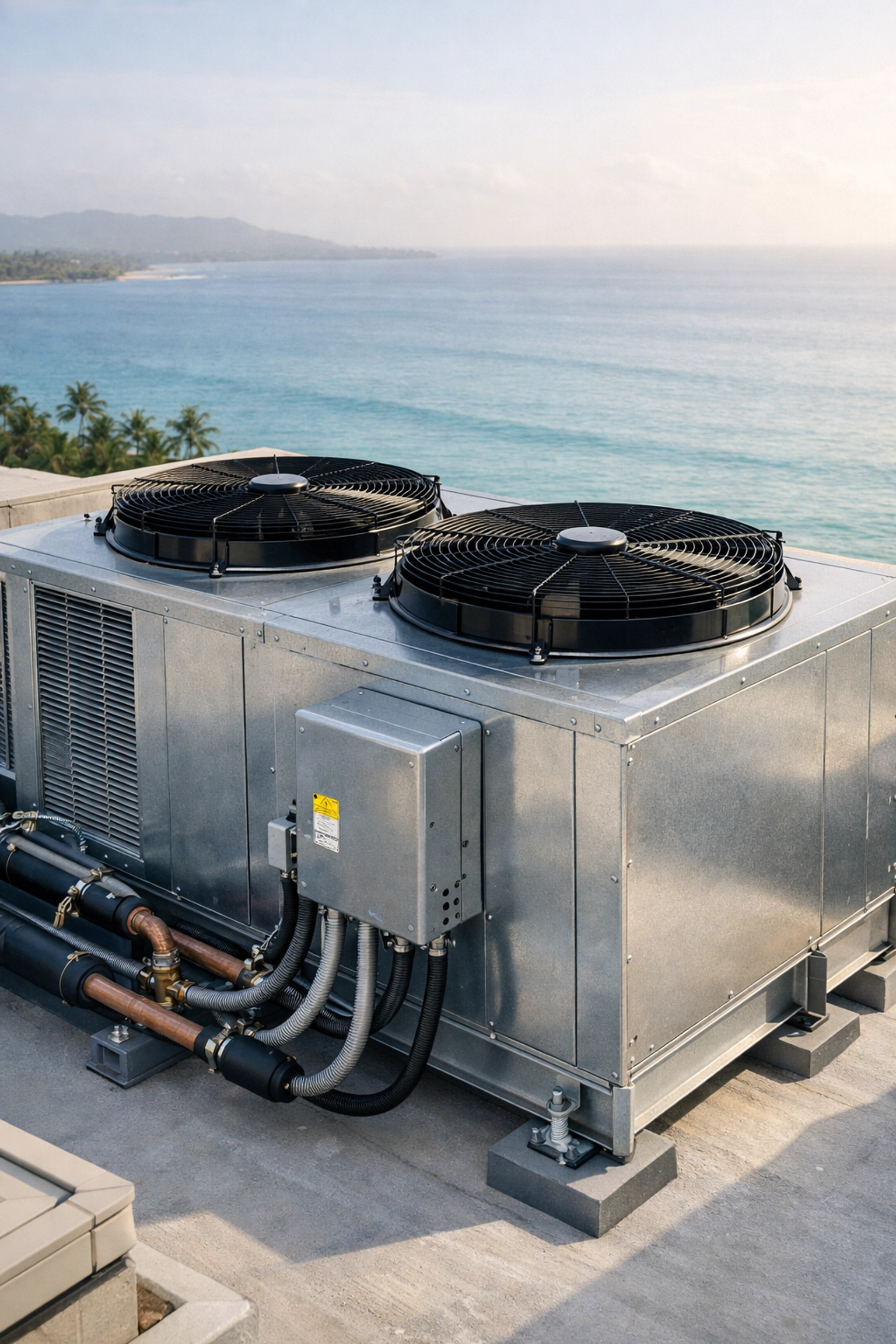
In Maui and Oahu, we live in a beautiful but corrosive paradise. The very trade winds that keep our guests comfortable are carrying salt spray that behaves like sandpaper on your condenser coils. One of the biggest mistakes we see is using mainland maintenance schedules for coastal Hawaiian properties.
Standard cleaning isn't enough when you're dealing with "salt creep." Without specific corrosion-resistant treatments and frequent, specialized rinsing, your unit’s efficiency will drop by 20% in the first year alone. This leads to higher energy bills and compressors that burn out years before their time. If your service provider isn't talking about "Mālama Āina" for your machinery, they aren't service-ready for the islands. You can read more about building for our unique climate here.
3. Surface-Level Cleaning vs. Hydro Jetting
Many property managers believe their coils are clean because they look "okay" on the outside. This is a dangerous assumption. Traditional garden-hose rinsing or light brushing only pushes dirt and salt deeper into the center of the coil fins, creating a "compacted sandwich" of grime that chokes the system.
This is where Alltemp’s Hydro Jetting technology becomes a game-changer. Standard cleaning methods often miss the core of the coil, leading to "high head pressure" and eventual compressor failure. Hydro Jetting uses specialized pressure and water volume to clear the entire depth of the coil without damaging the fragile fins. If you’re curious about the physics of it, check out why jet coil cleans matter for HVAC-R efficiency.
4. Flying Blind Without Smart Monitoring
It is 2026; why are we still relying on a kitchen manager to "notice it feels warm" in the walk-in? One of the costliest mistakes is the lack of real-time, remote monitoring.
Smart Monitoring systems can detect a 2-degree drift in temperature or a spike in energy draw that signals a failing motor long before the ice starts to melt. For Oahu property managers handling multi-site facilities, being able to see the health of every refrigerator and ac repair maui unit from a single dashboard isn't just a luxury: it's risk management. Without it, you are essentially waiting for a disaster to happen. These smart cooling solutions are becoming the standard for modern Hawaiian infrastructure.

5. The "Cheap Tech" Trap: Vetting Your Service Provider
Research into industry complaints reveals a frustrating pattern for Hawaii business owners: double-billing, diagnostic fees that don't apply to repairs, and "phantom fixes" where a technician leaves, only for the system to fail 48 hours later.
The mistake here is choosing a service provider based solely on the lowest hourly rate. A "cheap" tech who takes three visits to fix a leak is far more expensive than an expert who fixes it once. When vetting a refrigeration service Hawaii, ask about their diagnostic process. Do they provide written confirmation of the fix? Do they guarantee their work? Incomplete repairs and poor communication are the hallmarks of a provider that will eventually cost you your peace of mind.
6. Neglecting Indoor Air Quality (IAQ) and Humidity Control
In the hospitality sector, refrigeration and HVAC are two sides of the same coin. A common mistake is focusing so much on the temperature of the walk-in that you ignore the humidity and air quality of the surrounding kitchen or prep area.
High humidity in a kitchen makes your refrigeration units work twice as hard to maintain temperature every time the door opens. Furthermore, poor indoor air quality can lead to mold growth on vents and evaporator coils, which eventually finds its way into food storage areas. Maintaining a holistic view of indoor air quality and HVAC resilience is essential for both guest comfort and food safety compliance.

7. Being Caught Off Guard by the Refrigerant Transition
The regulatory landscape is shifting beneath our feet. The AIM Act and the transition away from high-GWP (Global Warming Potential) refrigerants are no longer "future problems": they are current realities.
Many businesses are making the mistake of investing in major repairs for old systems using R-404A or R-22 without a phase-out plan. As these refrigerants become scarcer, their prices skyrocket. Continuing to "top off" a leaky, old system is like pouring liquid gold into a sieve. You need to know what Hawaii businesses need to know about the 2025 refrigerant transition to ensure you aren't throwing good money after bad.
How to Fix the Cycle: A Strategic Approach
So, how do you stop making these mistakes? It starts with a shift in perspective. Instead of seeing your refrigeration service Hawaii as a line-item expense, see it as a pillar of your revenue protection.
Audit Your Coils: If you haven't had a Hydro Jetting deep clean in the last six months, your energy bills are likely 15-30% higher than they need to be.
Implement Monitoring: Get eyes on your equipment 24/7. The cost of a monitoring sensor is a fraction of the cost of one spoiled crate of mahi-mahi.
Plan for 2027: Start looking at your equipment lifecycle now. With Hawaii's energy future leaning toward smarter, more efficient rooftops, your old, "reliable" units might be your biggest liability.
At Alltemp, we don’t just "fix fridges." We partner with property managers to ensure that the unique challenges of the Hawaiian environment don't dictate your bottom line. Whether it’s specialized ac repair maui or a complex refrigeration overhaul on Oahu, the goal is the same: maximum uptime, minimum stress, and a system that respects both your budget and the island we call home.
Would your current refrigeration systems earn a passing grade if evaluated today? If the answer is "I'm not sure," it might be time to stop making these seven mistakes and start building a more resilient facility.
Comments